Does your church operate a school or pre-school? Is the church aware of Federal regulations on emergency egress drills for church schools?

Recently, one of our Nevada churches asked for clarification on egress and door security requirements during emergency drills. After consulting with the National Fire Protection Association (NFPA) and the local fire chief, it was determined a church school employee was given some erroneous information (“main entrance doors and all interior rooms are to be unlocked from the outside during school hours and during emergency drills”) and this information was then passed on to church leadership as “new regulation.” This misunderstanding highlights the importance of ensuring that school safety regulations are known, understood and accurately communicated.
Church educational operations fall under federal regulations. Educational occupancies, defined in NFPA 1, Fire Code, and NFPA 101®, Life Safety Code® as “an occupancy used for educational purposes through the twelfth grade by six or more persons for 4 or more hours per day or more than 12 hours per week” include preschools, elementary schools, high schools, and the like.
Emergency Drills For Schools
Schools in America today have secured their buildings from the exterior with controlled primary access points. Interior doors are locked on the outside and allow occupants to egress (exit) from the inside. This practice helps to safeguard building and classroom occupants from external threats gaining access inside.
Emergency Egress (fire) Drills for Schools
Under the National Fire Prevention Association (NFPA) Life Safety Code, schools must complete Emergency Egress (“Fire”) Drills. Under the code, schools are required to complete a minimum of six (6) drills during the school year (detailed below).
Egress evacuation drills result in a complete evacuation of the school and the code requires that minimally two egress drills be completed. The remaining four (4) fire drills, at the discretion of the school authority, may alternate between a relocation drill and an egress drill.
Relocation drills provide schools with an opportunity to practice the relocation of students to an alternate location (building) in the event the primary school building is compromised in such a way that it cannot safely be occupied. These drills can be coordinated for the end of the school day in such a manner that the school community can practice the relocation process and parents can become familiar with the process of picking up their children at the alternate site.
- Emergency evacuation plans are designed to evacuate the school in the most efficient and safe manner without panic. Without practicing drills, occupants including school staff will not know how to implement their emergency action plans.
- School fires and other emergency conditions may arise warranting the complete evacuation of the school in a timely manner. Thus, schools must be prepared to initiate such emergency evacuations.
Why Are Emergency Drills For Schools Important
The purpose of these drills is to educate participants about the building’s fire safety features, the available egress routes, and the procedures to follow. While quickly evacuating buildings or relocating occupants is important, it is just one of several objectives. Equally important are teaching occupants the escape routes and ensuring that these routes remain unobstructed and well-maintained by the church or school.

When Are Emergency Drills For Schools Required
Generally, egress drills are required by the Code to be conducted at least once every month when the educational facility is in session, and sometimes twice within the first 30 days, unless located in a climate with severe weather (cold, heat, etc.). All occupants of the building are required to participate in the drill and all emergency drill alarms are to be sounded on the fire alarm system so as to not confuse students and staff as to the required action.
The concept behind the requirement that emergency drills be conducted at the start of the school year is that training without the hands-on instruction accomplished by drilling does not guarantee that students will be familiar with the egress routes and able to interact with others during an emergency evacuation or relocation.
Do The Codes Address Drills For Non-Fire Events
In addition to drilling students and staff in response to a fire emergency, non-fire events such as a targeted-violence event or a natural disaster also require drills. The need to train and drill on multiple scenarios can put a strain on resources, time and patience. Because of this, NFPA 1 and NFPA 101 (as of 2021) allow up to two of the required emergency egress drills to consist of alternative emergency drills for one or both of the following:
- Targeted violence events
- Natural hazard events (Tornado, Severe Storm, etc.)
Additionally, NFPA 1 also addresses frequency, conduct, environment, and documentation for drills.

Jurisdictional Authority
Jurisdictional Authority (School Boards) across the country is including language for “options-based response drills, including fire drills” which requires that all drills must be age appropriate. Therefore, more planning is required to ensure that response drills, especially those for violent intruders, are tailored to be age-appropriate, as opposed to the more straightforward fire drills. The guidance provided below includes trauma-informed best practices for implementing options-based response drills.
Announcing Fire Drills
It is recommended that fire and relocation drills should not be announced with “specific details” regarding date and time of the drill to the public. Announcing the date and time of a drill creates an undue risk to students and school staff. Instead, it is recommended that fire and relocation drills should be announced several days before the drill with a “general statement” that a drill will be held in the coming days, no later than X day.
This approach is designed to balance the safety of students and staff who participate in the drill with parents’ need to be informed of an upcoming drill.
Options-Based Response To Violent Intruder Drills
Since 2015, school boards have been moving away from the traditional (Lockdown) approach to an active shooter. Review of different response methods and data analysis related to past active shooter incidents has shown that no one-size response plan fits each active shooter incident. Teachers, administrators, and students need to have an options-based response approach available to them, based on specific circumstances at the time of the incident.
Example Schedule: Emergency Egress & Options Based Drills
To meet the requirements of the NFPA Life Safety Code, schools must complete the minimum number of drills (6), and the method of drills listed below. Schools may choose to complete additional drills at their discretion.

Guidelines for Options-Based Response to a Violent Intruder Drill
Prior to conducting emergency drills for schools, school leadership teams should review two important resources to help ensure that all options-based drills are age-appropriate, and trauma informed:
- Best Practice Considerations for Armed Assailant Drills in Schools, is produced by the National Association of School Psychologists and the National Association of School Resource Officers.
- Creating School Active Shooter/Intruder Drills, is produced by the National Child Traumatic Stress Network Guidance document, which states: “Safety drills need to incorporate a lockdown response but also an “option-based” approach. An option-based approach means that there are different actions educators and students can take if confronted by an active shooter/intruder (e.g., run away, keep out, and hide). The district needs to evaluate which approach is best and to adapt that approach to the developmental level of their students, including for students with disabilities, language barriers, and mobility needs.”
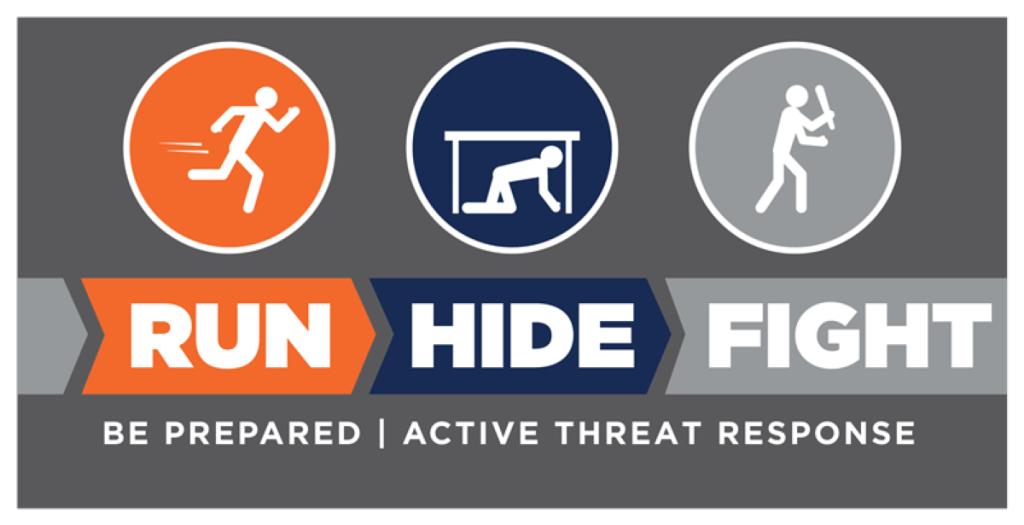
Recommendations for Age-Appropriate Options-Based Drills in Response to a Violent Intruder
Schools are encouraged to adopt the Run, Hide, Fight methodology for responding to a Violent Intruder. Run, Hide, Fight is the U.S. Department of Homeland Security’s (DHS) recommended actions when responding to a Violent Intruder. It does not replace current safety protocols for evacuation, sheltering in place or other emergency response procedures.
Instead, Run Hide, Fight gives additional tools that may be used in response to a Violent Intruder. The Run, Hide, Fight concept is to:
Run – If you can safely escape the area of the threat do so. You must make a decision based on the best information available at the time.
- Can be faculty, staff, or student-initiated
- Have an escape route and plan that includes identified assembly areas located a safe distance away from the incident (Accountability)
- Leave personal belongings behind
- Must be prepared to change evacuation/run routes based on situational awareness
- Be prepared to transition to a hide or fight option based or situational awareness
- Keep your hands visible
Hide – Find a safe location to hide and avoid detection and potentially reinforce and “harden” your location.
- Take steps to barricade, reinforce, or fortify your location
- Lock doors and use items such as desks, chairs, bookshelves to barricade the door
- Turn lights off
- Hide in an area out of the view of the potential threat (try to ensure students and staff are not all congregated in one area)
- If safe to do so, close all window shading
- Silence Cell Phones
- Maintain silence
- Do not open the door
Fight – When faced with no other option, you may need to confront an active threat with the resolve that you will survive the encounter.
- Consider developing a plan with others in your location to determine the best options for your survival (Swarming, distraction)
- Last option for survival
- Must assess individual capabilities
- Enhance survivability by utilizing available resources (fire extinguisher, books, heavy objects) to defend or protect yourself
Author Resource Publications – Click HERE
FAQ
The primary objectives are to ensure that all occupants know how to quickly and safely evacuate the building in an emergency, to familiarize everyone with the egress routes, and to test the effectiveness of the Emergency Plan.
An effective drill plan should include clear instructions for evacuation routes, assigned roles and responsibilities for staff, procedures for accounting for all occupants, communication methods during the drill, and debriefing sessions to review performance and address any issues.
Yes, regulations and standards can vary by location but generally include guidelines from the National Fire Protection Association (NFPA), and local fire codes. It’s essential to be familiar with and adhere to the specific regulations applicable to your area.
Schools should develop and implement individualized evacuation plans for students and staff with disabilities. This may include assigning specific staff members to assist with evacuations, using accessible egress routes, and incorporating specialized equipment or procedures. Regular training and drills should be conducted to ensure that everyone is prepared and that these plans work effectively.
Related Content
Summary
Having a clear understanding of and maintaining compliance with state and federal school safety protocols is essential for safeguarding our church’s educational operations. Since regulations in this area change periodically, it is important to stay informed. We recommend churches conduct an annual review of safety protocols, along with related church policies and procedures, to ensure they remain current and in compliance.
Public Safety Training LLC | Church Security-101 is here to serve and has established training and consulting programs and publication resources available to help. We would be honored to assist your church and security team in any way that we can. Contact us today!
Michael Elerick is the President of Public Safety Training LLC, a church safety and security training and consulting company. He retired from law enforcement as a Special Operations Commander and SWAT Commander. He served as the Executive Director for the Public Safety Training Institute (2010-2020), a non-profit public safety training organization, and has over three decades of experience as a Risk Manager and Security and Tactical expert. He is the author of Church Safety & Security 101, Emergency Preparedness for Church Volunteers, Church Security Team Development, Church Emergency Operations Plan (EOP), among other works.