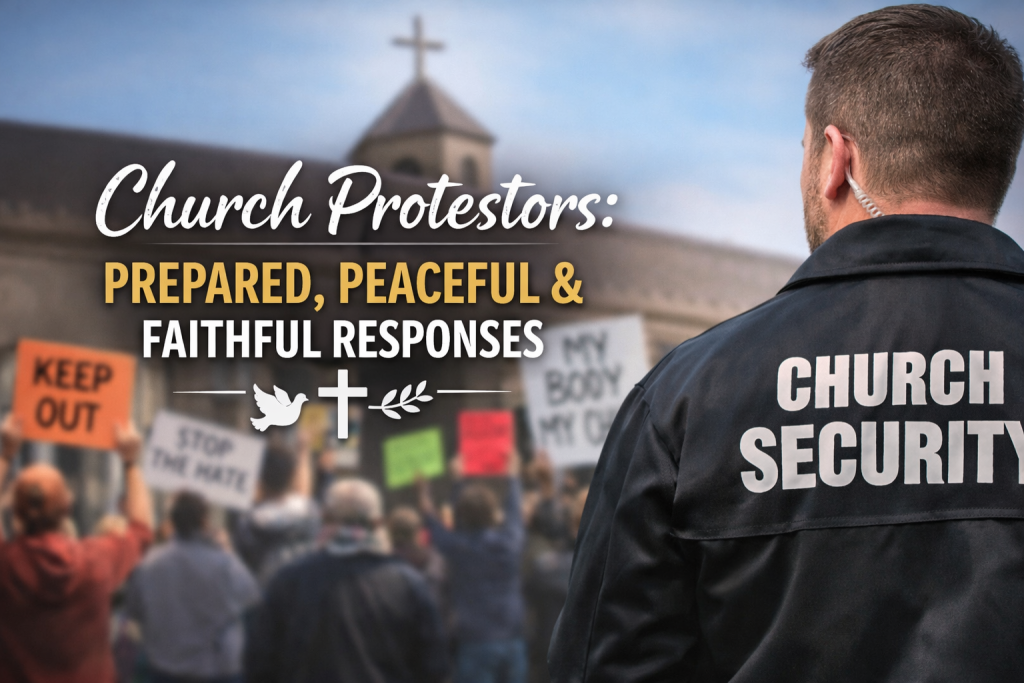
This post focusses on “Church Protestors: Prepared, Peaceful, and Faithful Responses.” Churches today face a reality many never anticipated – organized protests, disruptive behavior, and intentional challenges to church beliefs and policies. While the Church must always remain welcoming and Christ-centered, it must also be wise, prepared, and protective of its people – the “Body of Christ.”
“Be wise as serpents and innocent as doves”
Matthew 10:16
Church safety and security is not about confrontation – it is about stewardship, discernment, and protecting the flock God has entrusted to us.
understanding church protesters
Protest activity at churches often centers around deeply held moral, cultural, or doctrinal disagreements. These situations may include:
- Demonstrations on church property
- Disruptions during worship services
- Challenges to church policies, including restroom & facility use
- Attempts to provoke and record confrontation or public incidents
While protesters may claim public-accommodation rights, churches are private religious organizations with the legal authority to establish and enforce policies consistent with their faith and mission. This means we can prohibit protesters (anyone causing a disruption or suspected of behavior that is incongruent with our policies) on our property and in our buildings.
a christ-centered safety philosophy
A well-trained church safety team approaches protest situations with three guiding principles:
- Protect people first, especially children, women, and vulnerable individuals
- Preserve worship and ministry without unnecessary disruption
- Model Christian character through calm, respectful, and lawful actions
This is not weakness – it is disciplined strength.
disruptive person(s) policy
Policy Mitigates Disruptions
A clearly written Disruptive Person(s) Policy is one of the most effective tools a church can use to mitigate protest activity before it escalates. Rather than reacting emotionally or improvising in the moment, the policy provides a calm, pre-established framework that guides leaders and safety teams in responding to disruptive behavior – regardless of the individual’s cause, message, or motivation.
By defining expectations, boundaries, and escalation steps in advance, churches eliminate confusion, reduce hesitation, and protect staff and volunteers from having to make high-pressure judgment calls. Most importantly, a Disruptive Person(s) Policy helps preserve worship, safeguard vulnerable congregants, and ensure responses are marked by both grace and firmness – reflecting the biblical call to maintain peace and order within the body of Christ.
If your church does not currently have a Disruptive Person(s) Policy in place, download our FREE policy template above and use it to develop a plan tailored to your ministry. Preparing now equips your staff and volunteers to respond wisely, lawfully, and confidently – long before a disruption or protest ever walks through your open doors.
restroom protesters
Many faith-based organizations maintain restroom policies based on biological sex, not gender identity. These policies exist to protect privacy, dignity, and safety – especially for women and children.
When a biological male intentionally enters a women’s restroom, church staff and safety teams are trained to treat it as a privacy and safety concern, not a theological debate.
The response is measured and deliberate:
- Observe and assess the situation
- Redirect politely and clearly
- Enforce church policy if refusal occurs
- Involve leadership or law enforcement if necessary
Grace and firmness are not opposites. They work together.

de-escalation before enforcement
Church staff and safety teams should be trained to redirect first, not accuse. A calm statement such as:
“Sir, this is the women’s restroom. The men’s restroom is just over here – can I help you find it?”
This communication style often resolves the situation immediately. When it does not, the church still has both the moral responsibility and the legal authority to act.
when church protesters refuse to comply
If a protester refuses to follow church policy or leave private property:
- Safety Team leadership is notified
- The individual is informed they are trespassing
- Law enforcement is contacted if refusal or threats continue
- The incident is documented
This is not about punishment – it is about boundaries.
a faithful witness in difficult moments
Churches do not prepare for protesters out of fear, but out of faithfulness. Order allows worship to continue. Clear policies protect volunteers from uncertainty. Training allows compassion to remain intact even under pressure.
“For God is not a God of confusion but of peace”
1 Corinthians 14:33
Prepared churches are peaceful churches – and peaceful churches are strong witnesses in a confused world.

faq
Yes. Churches are private religious organizations, not public forums. This gives them the legal right to establish and enforce policies – including behavior, access, and facility use – so long as they are applied consistently and lawfully. Enforcing boundaries on private property is not discrimination; it is stewardship and responsibility.
No. Safety teams are trained to observe, redirect, and protect – not debate theology, politics, or policy. Engaging in argument often escalates situations and distracts from worship. Calm redirection and clear boundaries are the most effective and Christ-honoring responses.
If a protester refuses to comply after a clear and polite request, the situation becomes a trespass issue. At that point:
1. Safety Team leadership is notified. 2. The individual is informed they must leave the property. 3. Law Enforcement is contacted if refusal continues. This protects the congregation and removes enforcement responsibility from volunteers.
Churches that designate restrooms by biological sex may lawfully enforce that policy. Safety teams are trained to 1) Redirect politely first. 2) Clearly explain church policy if needed. 3) Offer alternative accommodations when available. 4) Required departure if the individual refuses to comply. The focus remains on protecting privacy, safety, and dignity, especially for women and children.
Preparation is not fear – it is faithfulness. Written policies, trained safety teams, and clear communication allow churches to respond peacefully, confidently, and consistently. When leaders prepare wisely, the congregation can worship freely and without distraction.
related content
- The Law of Self-Defense
- Church Safety Volunteers
- Children’s Ministry: First Impressions that Build Faith
Publication resources
OUR COMMITMENT TO YOU
Our church safety & security blog, newsletter, and FREE Resource Library, is provided at no cost to strengthen and support church safety programs. This work is made possible by those who support us through the purchase of our guidebooks and faith-based policy templates. We invite you to explore our publications on AMAZON or in our ONLINE STORE. Your support helps us continue serving those who serve His Church.
Public Safety Training LLC would be honored to assist your church and safety team in any way we can. Contact us today!
AUTHOR
Michael Elerick is the President of Public Safety Training LLC. A career law enforcement professional, he retired as a Special Operations Commander with more than 30 years of experience in risk management, tactical operations, and security. From 2010 to 2020, he served as Executive Director of the Public Safety Training Institute.
Since 2010, Michael has trained and consulted with faith-based organizations across the country. He is the author of Church Safety & Security 101, Emergency Preparedness for Church Volunteers, Church Safety Team Development, Church Emergency Operations Plan (EOP), and other works focused on equipping ministries to protect their people and fulfill their mission.
Please Share this information – Spread the Love!