A Church Active Threat is defined as: A person actively attempting to cause harm through violence, weapons, or other dangerous means, and where there is an immediate need for protective action.
The most recognized active threat, is the “Active Shooter.” While church active shooters are rare, statistically less common than winning the lottery, the impact on those who defy the odds can be devastating. Talking about these horrific acts of evil is not easy either, especially with some segments of our congregations. But this topic is on the minds of many of our church members and staff, especially those with children, because of church active shooter incidents that continue to occur both here in America and around the world.

Talking about church active threats, in the context of prevention, is actually how we can reduce the fear and anxiety toward these issues. When an act of church violence becomes national news, we should strive to take a moment to acknowledge the incident with our congregations, to pray for those involved who may have been harmed and then explain the response plan’s that your church and safety team has in place to stop similar incidents from occurring. In this post we’re going to discuss church active threats and why these incidents are so deadly, how knowledge, preparation, and training is the primary way to stop these incidents from occurring and mitigating the damage caused if they do occur.
Equipping church volunteers and congregations with the necessary tools and knowledge to navigate the unthinkable is not an act of fear, but one of preparation and love. As stewards of safety and security, it is our responsibility to teach and cultivate vigilance as we serve one another along this journey. Through regular discussions on these known threats and emergency preparedness training, we can strengthen our church culture to better detect church threats early (See Something – Say Something) before they cause significant harm.
Church Active Threats
To understand the necessity for churches to develop active threat Emergency Action Plan’s (EAP’s) and to conduct emergency preparedness training with their volunteer units and congregations, we must look a little deeper into the mindset of an active shooter and gain a broader perspective as to this need.

Is an active shooter a criminal or terrorist?
When a person commits a criminal act (Burglary, Robbery, Assault, etc.), it is usually an opportunistic act, and the person’s intent is to obtain something (valuables, revenge, etc.) and get away with the act without being caught or identified, in most cases. A terrorist act is different, philosophically, it is a symbolic act, and the terrorist goes into the act expecting and intending to kill as many people as possible and then to die during the act, either by suicide, or confrontation with law enforcement or others. This is why active shooter incidents are terrorist acts and have the potential for significant loss of life if plans are not in place to detect, prevent and mitigate these threat hazards.
Active shooter is as incongruent with the teachings of Jesus Christ as anything can be and reveals the type of evil the church and congregation must be safeguarded from. When an active shooter incident is happening, there is no reasoning, or negotiating with this committed mindset. They are symbolically carrying out a pre-planned assault on the church’s congregation, and any attempt to reason or negotiate with the shooter during the act will be a fatal mistake; the church must have a pre-planned response in place to prevent an incident from happening and mitigate loss of life (if) an incident occurs.
When an active shooter incident does occur, they are unpredictable, evolve very quickly, and are over within 3-7 minutes on average; most often before law enforcement can arrive on scene. An active shooter’s intent is to kill as many people as possible before they are stopped and there is no pattern or method to their selection of victims. A shooter will not stop firing until their objectives have been met or they are engaged by law enforcement or civilian(s) and stopped.
Because active shooter incidents are statistically over within minutes and most often before on duty law enforcement is able to respond/arrive to the scene, church staff, members, and visitors are responsible for their own safety, and the safety of their families, until help arrives. Start training your mind right now to react quickly, if you hear or see a person shooting on the church campus (or work, school, shopping mall, etc.), immediately RUN in the opposite direction and get to a location of safety. Once safe, call 9-1-1 to notify authorities and request help.
church safety team: Armed Response
If your church has an Armed component of the safety team, the armed team members will immediately respond and engage the shooter in order to stop the threat and stop the innocent from being harmed. A church with an armed safety team response and a trained congregation will initiate a different Emergency Action Plan than churches without an armed safety team.
church safety team: unarmed response
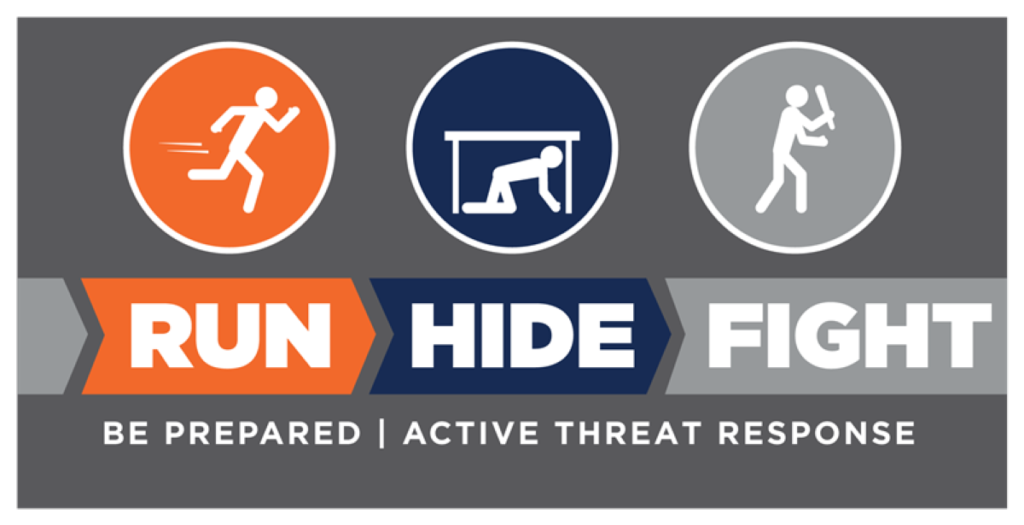
Church staff and congregations without an armed safety team should be trained to follow the Run-Hide-Fight ACTION STEPS.
ACTION STEPS: RUN-HIDE-FIGHT
YOU have three options during an active shooter incident:
- Run (get away)
- Hide (lockdown)
- Fight (defend self)
These action steps are listed in priority order; if you can Run and escape, do so; if you cannot run, because the shooter is between you and all other escape routes, you must Hide (Lockdown). Hiding means barricading yourself in a room or location where the shooter does not have direct access to you or others who are with you. If you cannot Run, and you cannot Hide, you must be mentally prepared to Fight in order to defend yourself and those around you.
Preparation (Training) is key – thinking through each of these options in the calmness of a Sunday School classroom training session is preferred over learning them firsthand during a real emergency. There are ways to lockdown/barricade a Sunday school classroom, or church office door, if “How To” discussions and preparation take place ahead of time. Churches can also prepare their congregations to evacuate church buildings by conducting periodic fire drills; we do not have to call them active shooter drills as the fire drills walk everyone through the same emergency evacuation routes that we want the congregation to learn should a future active threat or shooter type situation occur.
By Failing to Prepare, You Are Preparing to Fail!
Benjamin Franklin
RESPONSIBILITIES
If you witness an active shooter incident:
- Get to safety then call 9-1-1.
- Notify the church so Emergency Evacuation and/or Lockdown Protocols can be activated.
Church Administration
- All efforts immediately focus on Life Safety protocols.
- Initiate campus Emergency Notification Systems (Check out TextInChurch.com).
- Initiate Emergency Evacuation and/or Lockdown orders, depending on circumstances.
LOCKDOWN campus population that is in close proximity to the shooter.
EVACUATE campus population that is away from shooter location.
Safety Director and Church Safety Team – Armed
- Respond to shooter and stop the threat in order to stop the killing.
- Provide information to responding law enforcement via 9-1-1.
- If the location of the shooter is known communicate this to law enforcement.
- Unarmed church safety team members are not expected to get involved. Like all other unarmed and non-trained members, follow Run-Hide-Fight Action Steps.
Church Safety & Security Resource Publications: Click Here
What to Expect from Emergency First Responders
One of the hardest things to understand for those caught inside an active shooter scene is when help finally arrives, the first responding officer(s) will not stop to help the wounded or injured or evacuate you to a place of safety. Their MISSION is to locate and stop the shooter in order to stop the killing; we train officers that every gunshot that rings out is another life lost – our priority and responsibility is to find and stop the shooter. Know that medical and rescue teams will begin entering the scene and treating the injured as additional law enforcement resources arrive on scene.
It is also important to understand, the initial law enforcement officers are looking for an armed subject shooting people. Ensure you have nothing in your hands (put away the black and dark colored cell phones) and raise your hands up in the air so they can immediately visually eliminate you as a threat. If you know where the shooter is, or area the shooter was last seen, point in that direction, the officers may stop and clarify your information or continue running toward the stimulus (gunshots).
For information on our “Church Violence and Active Shooter Response Protocols“ training program, click on the link or the “Training” tab at the top of this page. We will provide a FREE training quote upon your request.
related content
Public Safety Partnership
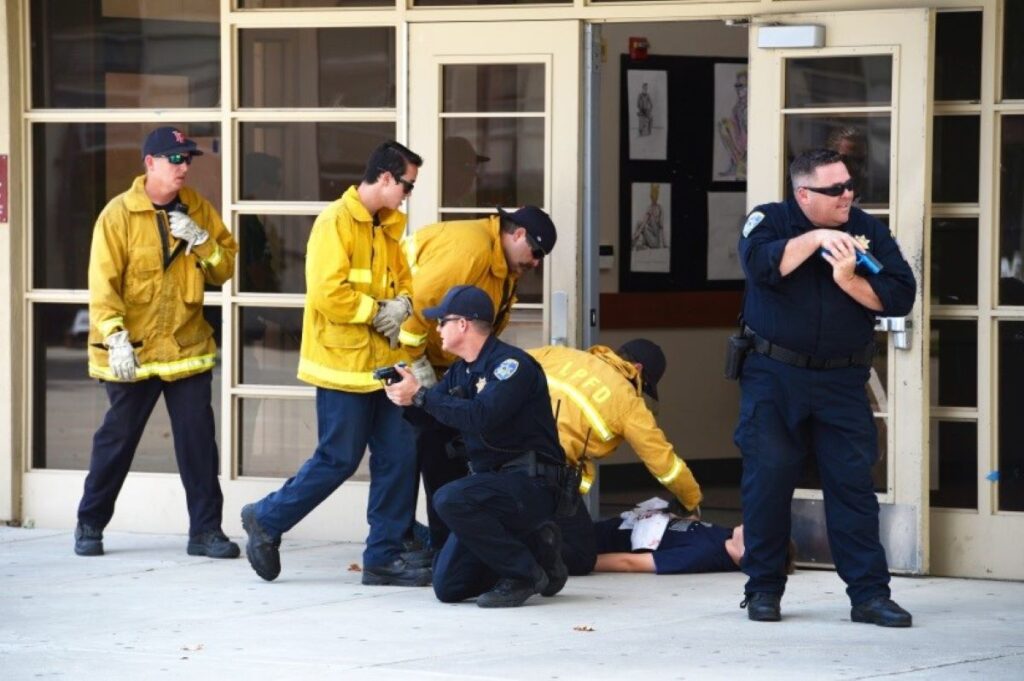
All churches should make an effort to create a public safety partnership with local law enforcement and fire departments and coordinate with public safety on related emergency preparedness training minimally once per year to understand how they will respond to an incident on church premises. For active threats and shooter incidents, contemporary jurisdictions will deploy Unified Response Tactics into these scenes; law enforcement will respond to stop the shooter followed by Rescue Task Force units (Law Enforcement providing armed escorts for fire/paramedics) into the scene to treat and evacuate the wounded and all others.
Unified Response Tactics – Rescue Task Force
- Initial law enforcement will respond to the scene, locate, and stop the shooter.
- Unified Command Post (LE and Fire will set up one (1) command post and manage the critical incident together).
- Rescue Task Force – LE and Fire begin deploying Rescue Task Force Teams to locate, triage and extract the injured.
- Law enforcement will simultaneously maintain a lockdown protocol as they systematically search the entire campus and evacuate all persons.
planning considerations
- Contact and coordinate with other response partners (Law Enforcement, Fire, Emergency Management Services, etc.).
- Emergency Evacuation Policy
- Lockdown Policy
- Active Shooter / Hostile Intruder Policy
- Facility “Go Box” (access keys/cards, maps of facility, etc.).
faq – frequently asked questions
The FBI defines an active shooter as one or more individuals actively engaged in killing or attempting to kill people in a populated area.
Having armed security is Biblical (Nehemia 4:9). Church violence is a reality in our World, and we must be prepared to respond and protect our church community from it. When a person with an evil intent shows up and starts harming our children, we do not have the time to call 9-1-1 and wait for law enforcement to respond to stop an act of violence in progress; it is our responsibility until law enforcement arrives and takes over.
A church’s highest priority must be the children entrusted in its care. Many churches train all staff/volunteers, including Sunday school teachers, in Emergency Preparedness Training, which includes Active Shooter response protocols. Churches with safety teams should also train to lockdown children’s classes and activities whenever an act of violence occurs on church property.
Church members play the most important role in safeguarding their church from violence by staying alert and aware of their surroundings and reporting any suspicious behavior to leadership or security personnel. Participation in Emergency Preparedness training, including active threat and active shooter response and emergency evacuation procedures, is important to ensure everyone knows how to respond in an emergency. Talking with church leaders about safety and security and getting involved in the church safety program further contributes to creating a safer church environment.
reference links
summary
When an act of church violence becomes national news, we as a church community should take the opportunity to acknowledge the evil act with our congregations, pray for those involved and explain how the church has prepared to respond to these types of acts. Let the church community know that there is an Emergency Action Plan in place to identify suspicious persons and behavior, and that they are a part of that plan and are encouraged to be vigilant and report anything they perceive as suspicious or a threat.
Should an act of violence occur, the church has an Emergency Action Plan (EAP) in place to stop the threat and mitigate harm. Preparing our congregations through these types of conversations and emergency preparedness training is the key to overcoming this evil. Congregations who have a plan in place and are trained in how to react within the plan’s framework, will overcome these terrible acts.
In closing, I’d like to suggest that these conversations should also take place in the home with our kids and loved ones. These incidents have occurred in churches, schools, workplaces, shopping malls, restaurants, movie theatres, and all other types of populated locations. Our family should have the same mindset wherever they are and to react quickly and move away from danger at its first sign. If not possible, they have to have a pre-planned mindset how they will react in order to stay calm and look for ways to safeguard themselves during these high stress moments.
Watch the Run-Hide-Fight training video below as a family and have those “What Would You Do” conversations from time to time. These conversations are actually training our brains how to react in these situations. In the future, if we should find ourselves in this highly stressful and chaotic situation, our brains go into auto pilot, and we will respond in the manner we answered the “What Would You Do” scenarios discussed previously.
Our Commitment To You
Our church safety & security blog, newsletter, and FREE Resource Library, is provided at no cost to strengthen and support church safety programs. This work is made possible by those who support us through the purchase of our guidebooks and faith-based policy templates. We invite you to explore our publications on AMAZON or in our ONLINE STORE. Your support helps us continue serving those who serve His Church.
Public Safety Training LLC would be honored to assist your church and safety team in any way we can. Contact us today!
Author
Michael Elerick is the President of Public Safety Training LLC and a retired Special Operations Commander and SWAT Commander. A career law enforcement professional with over 30 years of experience in risk management, tactical operations, and security; he served as Executive Director of the Public Safety Training Institute from 2010 to 2020.
Since 2010, Michael has trained and consulted with faith-based organizations across the country. He is the author of Church Safety & Security 101, Emergency Preparedness for Church Volunteers, Church Safety Team Development, Church Emergency Operations Plan (EOP), and other works focused on equipping ministries to protect their people and fulfill their mission.
Please Share this information – Spread the Love!